The Undergraduate Studies
span five academic years, with each year divided into two semesters. The ten semesters in total include five Winter Semesters (1st, 3rd, 5th, 7th, and 9th) and five Spring Semesters (2nd, 4th, 6th, 8th, and 10th). Each semester comprises at least thirteen weeks of instruction followed by a comparable examination period.
The aim of the studies is the progressive acquisition of knowledge and skills by students. More specifically:
Key Features
Main academic and educational elements of the undergraduate studies program

The Department’s Study Program is fully compliant with level 7 of National & European Qualifications Framework (Integrated Master)
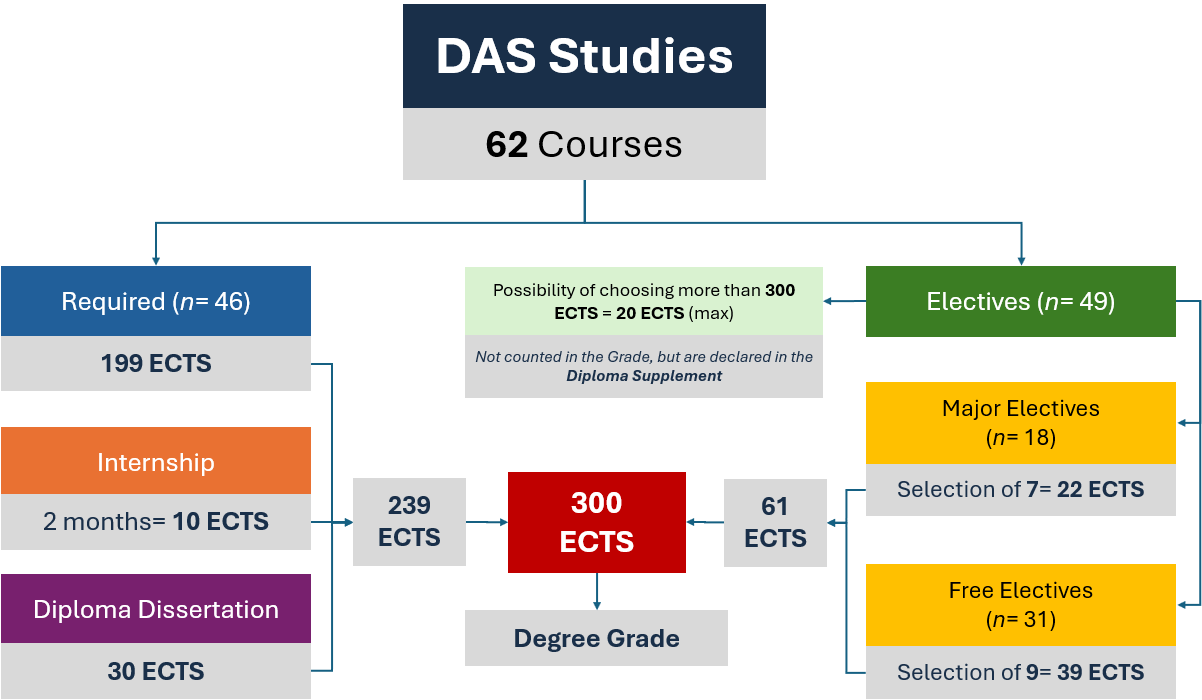
The Department of Animal Science curriculum comprises a total of 46 required courses, 18 major elective courses, and 31 free elective courses, providing students with comprehensive core knowledge, opportunities for specialization, and the ability to explore academic interests beyond the field of Animal Science.
These courses are organized into four main categories:
To fulfill the 300 ECTS required for graduation, students may select up to 16 elective courses (7 major and 9 free electives). Additionally, they may choose up to 20 extra ECTS from major or free electives, provided these are declared in advance as non-contributory to the final degree grade—they will appear only in the diploma supplement (SEE CHART). Find more information in the Studies Guide 2025 – 2026
Attending the curriculum on a full-time basis ensures completion of studies and award of the degree within five years from admission to the Agricultural University of Athens.
All courses in the Study Program correspond to credit units (ECTS), in accordance with the European Credit Transfer and Accumulation System (ECTS) and the guidelines of the European Higher Education Area. The ECTS the relative weight and workload of each course. Learn more about the ECTS system in the ECTS Guide
Total 300 ECTS over five (5) years (60 ECTS/Year)
The Internship constitutes an educational activity designed to provide practical application of the theoretical and scientific knowledge acquired through successful completion of the academic curriculum. It also familiarizes students with potential professional environments. The benefits of participating in the Internship include: a) an initial exposure to the professional field and the development of outward-looking, career-oriented skills, b) an understanding of current market trends and the competencies required, and c) the opportunity to apply academic knowledge in real-world settings relevant to students’ interests. It also allows students to explore various professional domains to identify the one offering them the greatest personal and professional benefit.
Read more about Internship
The Diploma Dissertation constitutes the culmination of the educational process of the Department of Animal Science. Its completion is mandatory for the award of the degree and accounts for a total of 30 ECTS credits within the study programme. During its preparation, the student is trained under the supervision of the Academic Advisor— a faculty member of the Department — with the aim of thoroughly addressing a scientific question directly related to the Department’s fields of study. The number of available diploma dissertations and their topics are determined by each supervisor.
Read more about the Diploma Dissertation
The Agricultural University of Athens implements student and staff exchange programmes, among which the most prominent is the European Programme ERASMUS+/KA1: Learning Mobility of Individuals.
The Department of Animal Science actively participates in the ERASMUS+ Programme by signing bilateral agreements with Higher Education Institutions located in Programme countries (see the List of partner Universities), through which student exchanges for study purposes and staff exchanges for teaching purposes are carried out annually.
In order to facilitate exchanges, members of the Department’s academic staff offer courses in the English language exclusively for ERASMUS+ incoming students. The list of these courses is regularly updated.
The ERASMUS+ Programme also funds student exchanges for traineeships and staff exchanges for training at institutions abroad. The Department’s students and staff actively participate in these activities as well.
All information regarding Programme opportunities and the participation procedures is available on the website of the European Programmes Office.
Upon successful completion of the study program, students will have acquired a range of knowledge, skills and competencies. The learning outcomes are measurable and demonstrate the capabilities of the Department’s graduates upon successful completion of the Undergraduate Studies. More specifically, graduates of the Department will be able (according to Bloom’s taxonomy):
The Academic Study Advisor (ASA) is a member of the Department’s Teaching and Research Staff whose primary responsibility is to support and guide the students who seek their assistance, with the aim of ensuring the effective organization and successful completion of their studies. For more information, please refer to the Academic Advisor Regulation.
Find your Academic Advisor (for active students):
Students of the Department of Animal Science can express and submit complaints or objections regarding the quality and functioning of the University’s services and decisions. The prerequisites, submission procedures, competent authorities, and the process for handling complaints or appeals are described in the Complaints and Appeals Management Regulation.
To submit your complaints please use the Complaint Submission Form (Word)
Useful Info
Find out the max duration of studies, the transfer admission exams conditions, as well as the professional rights and paths of our graduates
The maximum period of study is equal to the minimum number of semesters required for the award of the degree, increased by six (6) academic semesters. Please refer to the applicable legislation for more information:
You may enroll in the Department of Animal Science through transfer admission (qualifying) examinations, in accordance with the applicable legislation and the University’s Regulations on Transfer Admission Examinations. The examinations are open to graduates of:
Candidates are examined in specific subjects, which are determined each academic year by decision of the Department, and successful applicants are placed in a semester corresponding to their academic background. For the eligibility requirements, the number of available places, the examined subjects, and application deadlines, applicants are advised to consult the official announcements of the Department of Animal Science and the Agricultural University of Athens.
For detailed information please read the files below:
Graduates of the Department of Animal Science of the Agricultural University of Athens are awarded the Degree of Agricultural Sciences (Agronomist) with a specialization in Animal Production and acquire the professional rights of a Geotechnical Scientist, in accordance with Laws 1474/1984, 2040/1992, 4262/2014, and Presidential Decree 344/2000, as well as the right to exercise their professional activities, as detailed in Article 8 of Presidential Decree 344/2000. In addition, they acquire the professional rights of an Ichthyologist, in accordance with the conditions set out in Article 36 of Law 4440/2016.
The professional rights of geotechnical scientists and agronomists are defined and safeguarded by the Geotechnical Chamber of Greece (GEOT.E.E.), which regulates the practice of the profession through the aforementioned laws and regulations and ensures the protection of its members.
Specifically, the role of GEOTEE includes:
Registration with GEOTEE is mandatory for all graduates of the relevant schools.
Additionally, GEOTEE provides advisory and consultative support to ministries and universities, contributing to the design and updating of curricula to meet contemporary agricultural, environmental, and professional needs, while ensuring the international recognition of degrees.
Graduates of the Department of Animal Science of the Agricultural University of Athens acquire a set of skills that enables them to work:
A. As officers in the Public Sector and the wider Public Administration, such as:
B. As self-employed professionals in the Private Sector, such as: