LABORATORY of

Animal Breeding & Husbandry

About

The LAboratory of Animal Breeding & Husbandry is Directed by Professor Politis Ioannis and deals with teaching and research related to Livestock Production Systems, Physiology of Productive Traits, Ethology and Welfare, Genetics, Biochemistry, Genetic Technology and Biotechnology and Breeding of farm animals.

It hosts 8 Professors, 1 laboratory teaching member and 1 laboratory technician. The members of the Laboratory participate in various national and international research programs as well as in supporting the animal production sector in Greece by providing assistance in special breeding issues.

Laboratory History

The Laboratory Animal Breeding & Husbandry is an evolution of the Chair of General Animal Science that existed in the list of chairs based on the Founding Law of the Higher Agricultural School of Athens in 1920 and with the first Professor Ioannis Dimakopoulos. After the departure of Mr. I. Dimakopoulos, the directorship of the Laboratory was taken over by Professor A. Karadounias. Decisive for the further development of the Laboratory was the assumption of direction by Professor Mr. E. Rogdakis between 1979-2009, who gave a significant boost to both the educational and research activities of the Laboratory.

From September 2012 until today, the direction of the Laboratory is exercised by Professor Mr. Ioannis Politis.

The Laboratory serves the subjects of Farm Animal Breeding, physiology of Production Properties (meat, milk, eggs), Genetic Improvement, Molecular Genetics-Biotechnology, Quality of Agricultural Products, Production Systems and Ethology-Farm Animal Welfare.

The Laboratory, through the respective director, exercises the management of the Animal Farm of the Foundation as provided by the Founding Law of the Athens Higher School of Agriculture.

LABORATORY OBJECTIVES

The purpose of the Laboratory of Animal Breeding and Husbandry is:

  • to provide undergraduate and postgraduate students with theoretical and practical training in the subjects related to the Breeding of Monogastric and Ruminant Animals, and other categories of animals that are used for the production of useful for humans products, Livestock Production Systems, Physiology of Productive Properties, Ethology and Welfare, Genetics, Biochemistry, Gene Technology and Biotechnology, Genetic Improvement of farm animals (cattle, goats, sheep, pigs, birds, rabbits, etc.), the environment waste management and the effects of climate change on animal husbandry.
  • to produce basic scientific knowledge through the research carried out during the preparation of original bachelor’s and master’s theses, doctoral theses as well as from the research activities of the Laboratory’s staff.

Contact

LABORATORY
Animal Breeding & Husbandry
PHONE
+30 210 529 4430
LOCATION
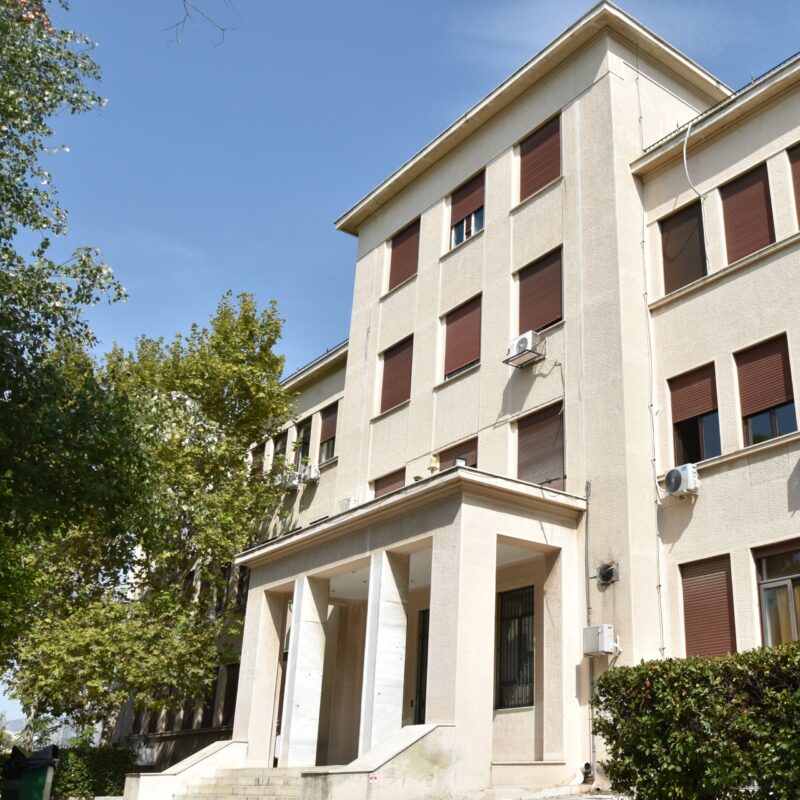
75 Iera Odos, 118 55, Dimakopoulos Hall, 2nd floor

Personnel

The Lab hosts 8 members of Teaching & Research Staff, 1 members of Laboratory Teaching staff and 1 Laboratory Technician
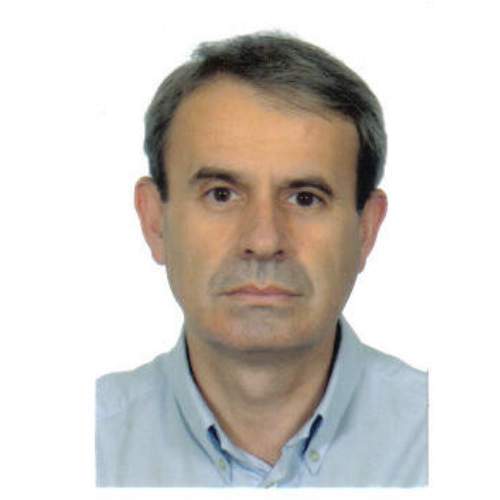

PROFESSOR, Laboratory Head
Politis Ioannis
EMAIL
i.politis@aua.gr
PHONE NUMBER
+30 210 529 4408
LOCATION
Dimakopoulos Hall, 2nd Floor
LABORATORY
Animal Breeding & Husbandry
PROFESSOR
Kominakis Antonios
EMAIL
acom@aua.gr
PHONE NUMBER
+30 210 529 4403
LOCATION
Dimakopoulos Hall, 2nd Floor
LABORATORY
Animal Breeding & Husbandry
ASSOCIATE PROFESSOR
Hager-Theodorides Ariadne
EMAIL
a.hager@aua.gr
PHONE NUMBER
+30 210 529 4453
LOCATION
Dimakopoulos Hall, 2nd Floor
LABORATORY
Animal Breeding & Husbandry
ASSOCIATE PROFESSOR
Simitzis Panagiotis
EMAIL
pansimitzis@aua.gr
PHONE NUMBER
+30 210 529 4427
LOCATION
Dimakopoulos Hall, 2nd Floor
LABORATORY
Animal Breeding & Husbandry
ASSOCIATE PROFESSOR
Koutsouli Panagiota
EMAIL
panagiota@aua.gr
PHONE NUMBER
+30 210 529 4440
LOCATION
Dimakopoulos Hall, 2nd Floor
LABORATORY
Animal Breeding & Husbandry
ASSOCIATE PROFESSOR, Chair Assist
Goliomytis Michael
EMAIL
mgolio@aua.gr
PHONE NUMBER
+30 210 529 4446
LOCATION
Dimakopoulos Hall, 2nd Floor
LABORATORY
Animal Breeding & Husbandry
ASSOCIATE PROFESSOR
Theodorou Georgios
EMAIL
gtheod@aua.gr
PHONE NUMBER
+30 210 529 4450
LOCATION
Dimakopoulos Hall, 2nd Floor
LABORATORY
Animal Breeding & Husbandry
ASSISTANT PROFESSOR
Laliotis Georgios
EMAIL
glaliotis@aua.gr
PHONE NUMBER
+30 210 529 4458
LOCATION
Dimakopoulos Hall, 2nd Floor
LABORATORY
Animal Breeding & Husbandry
LABORATORY TEACHING PERSONNEL
Stefos Georgios
EMAIL
gstefos@aua.gr
PHONE NUMBER
+30 210 529 4420
LOCATION
Dimakopoulos Hall, 2nd Floor
LABORATORY
Animal Breeding & Husbandry
LABORATORY TECHNICIAN
Biniari Eugenia
EMAIL
j.biniary@aua.gr
PHONE NUMBER
+30 210 529 4445
LOCATION
Dimakopoulos Hall, 2nd Floor
LABORATORY
Animal Breeding & Husbandry
ADMINISTRATIVE PERSONNEL
Delimitros Konstantinos
EMAIL
kdel@aua.gr
PHONE NUMBER
+30 210 529 4430
LOCATION
Dimakopoulos Hall, 2nd Floor
LABORATORY
Animal Breeding & Husbandry

Research

Learn more about the research activities of the Laboratory

RESEARCH FOCUS

The Research Activities of the Laboratory of Animal Breeding & Husbandry involve the following thematic units:

  • Livestock farming (Configuration of productive systems and handling of farm animals with emphasis in the management, the ethology and welfare of the raised animal species for production).
  • Genetic breeding of farm animals. (Planning of programs of genetic breeding and estimation of genetic parameters in populations of farm animals).
  • Physiology of Productive traits of the farm animals. (Adipose tissue, enzyme activities, carcass traits of farm animals).
  • Quality of animal products (mainly study of the parameters related to the quality of meat and eggs, while strong emphasis is given to the quality of milk and other animal products).
  • Population, biochemical and molecular genetics of farm animals (isolation and characterization of genes, detection of DNA polymorphisms).

RESEARCH PROJECTS

Research programs with the participation of the members of the Laboratory of Animal Breeding and Husbandry:

  • Genome scanning and identification of genes controlling (re)production traits in broilers’ (2016-2020), Aviagen Ltd.
  • Innovation for Sustainable Sheep and Goat Production in Europe (iSAGE)’ (2017-2020), Horizon 2020 – Research and Innovation Framework Program.
  • SMAll RuminanTs breeding for Efficiency and Resilience (SMARTER) (2018-2022), Horizon 2020 – Research and Innovation Framework Program.
  • Genome Wide Association Scanning and Gene Network Analysis of Body Weight in broilers’ Grant: MIS 5005869. Union (European Social Fund – ESF) through the Operational Program Human Resources Development, Education and Lifelong Learning 2014-2020.
  • Development of new technologies for the management of extensively ruminants’ farming, Regional government of Hepirus, 2019-2021.
  • Different forces behind the development of genomic diversity in indigenous cattle strains and breeds in Greece and Germany, DAAD.
  • Climate Change in Agriculture (CLICHA), Erasmus + KA2 Action, European Union.
  • Training program for young poultry farmers, beginners and unemployed: Broiler Farming in the framework of «New Agriculture for a New Generation – Recharging Youth to revitalize the Agriculture and Food Sector of the Greek Economy» SNF – Rutgers University (USA).
  • Use of microalgae in the production of novel yoghurt-type products. RESEARCH – CREATE – INNOVATE 2nd Round.
  • Acid whey from yogurt: Turning an environmental burden into innovative added value end products. RESEARCH – CREATE – INNOVATE 2nd Round.
  • Scientific support on milk quality issues. Union of Agricultural Cooperatives of Naxos
  • Study of proteolytic processes in ovine milk, MINERVA SA.
  • Development of subclinical mastitis screening tests for small ruminants with laboratory and point of care application, co-financed by Greece and the European Union (European Social Fund- ESF).
  • Evaluation of immunomodulatory and antihypertensive properties of dairy byproducts and investigation of their effect on calcium and iron absorption by the intestinal epithelium, State Scholarship Foundation.
  • Innovative utilization approaches and comparative advantages of Cheese Whey of ovine/caprine origin from the region of Epirus, Regional government (Epirus-Greece).
  • Implementation of innovative technologies in the production of yogurt with enhanced biofunctional properties, Cooperation 2011, GSRT.
  • Genomic selection in dairy sheep’. Action: “Cooperation 2011” (2013-2015). Ministry of Education and Religious Affairs.
  • Self-sufficient production of beef meat of fine quality. Action: PAVET 2013 (2014-2015). Ministry of Education and Religious Affairs.
  • Iron bioavailability in dairy products, Biokid.
  • The biological value of soy, JSK Hellas.
  • The effect of vitamin E in the antioxidant capacity of dairy cows, DSM Nutritional Products.
  • Thalis – «The effects of antioxidants’ dietary supplementation on animal product quality, EU and Greece.
  • Developmental programming in rabbits: Effects of maternal nutrition on the productivity, physiology and behavior of the offspring.

PARTICIPATION IN ORGANIZATIONS

The laboratory staff participates in National and International Organizations such as:

  • European Federation of Animal Science
  • Hellenic Society for Animal Science
  • Hellenic Poultry Association
  • Geotechnical Chamber of Greece
  • World Rabbit Science Association, Greek Branch
  • World Poultry Science Association, Greek Branch
  • Poultry Science Association (USA)

Extension Services

Information for services provided by the Laboratory upon request

Infrastructure

Explore the facilities and the equipment of the Laboratory used in research

The Laboratory Equipment and General Facilities serve the educational as well as the research activities in the scientific fields of livestock farming, physiology of productive traits, domestic animal ethology and welfare, genetic breeding and improvement, gene technology and biotechnology and quality of farm products.

The experimental studies involve the area of metabolism of adipose tissue, enzyme and hormonal detection, isolation and detection of proteins and nucleic acids (DNA and RNA), the qualitative control of products of animal origin (meat, milk, eggs etc.), the phylogenetic analysis based on different sources of genetic diversity. In this context the applied methods and techniques involved are from Physics, Chemistry, Biochemistry, Microbiology and Molecular Biology combined with the necessary infrastructure and instrumentation, like IT (Information Technology) facilities (e.g. networked computers and peripherals etc.), and laboratory spaces of experimentation with safety provision and storage of biological materials, needless to say, these would be impossible to conduct the relevant research without.

The Laboratory of Animal Breeding and Husbandry has the responsibility of management of the farm animals in the animal Experimental Stations of the Department. The farm allocates stable installations for the stock farming of veal calves, sheep and hens (dairy cows and sheep milk stations, egg hatching, nestling growth chambers and spaces for the storage and forage production).

The Laboratory of Animal Breeding and Husbandry accommodates in its premises:

  • Deionised and distilled water purification system
  • Gases abductor cabinets (hoods) for volatile solvents and reagents
  • Spectrophotometers
  • Cooling bench top centrifuges, pH-meters of various types
  • Ice machines, refrigerators +4oC and freezers at -20oC and -80oC and liquid nitrogen tanks for storage and preservation of biological material
  • Lab space allocated exclusively for the use of radioactive material, Geiger-Müller counter, nucleic acid hybridization chambers and dark room for the film development (autoradiography)
  • Fully equipped cell culture room (incubators, hoods and modern microscopes)
  • Fast autoclaves for the sterilization of nutritious and other liquid materials and constant temperature stirrers for the microbiological cultures
  • Fully equipped electrophoretic apparatus for DNA and proteins with the necessary image processing apparatus
  • Thermo cycler devices (PCR machines) for the selective amplification of nucleic acids and light cycler (Real Time PCR)
  • Instruments for measuring meat tenderness
  • Flow Cytometry Facility equipped with an analyzer and a cell sorter,
  • Next generation sequencing facility equipped with an Illumina Miseq sequencer